Truly Seeing
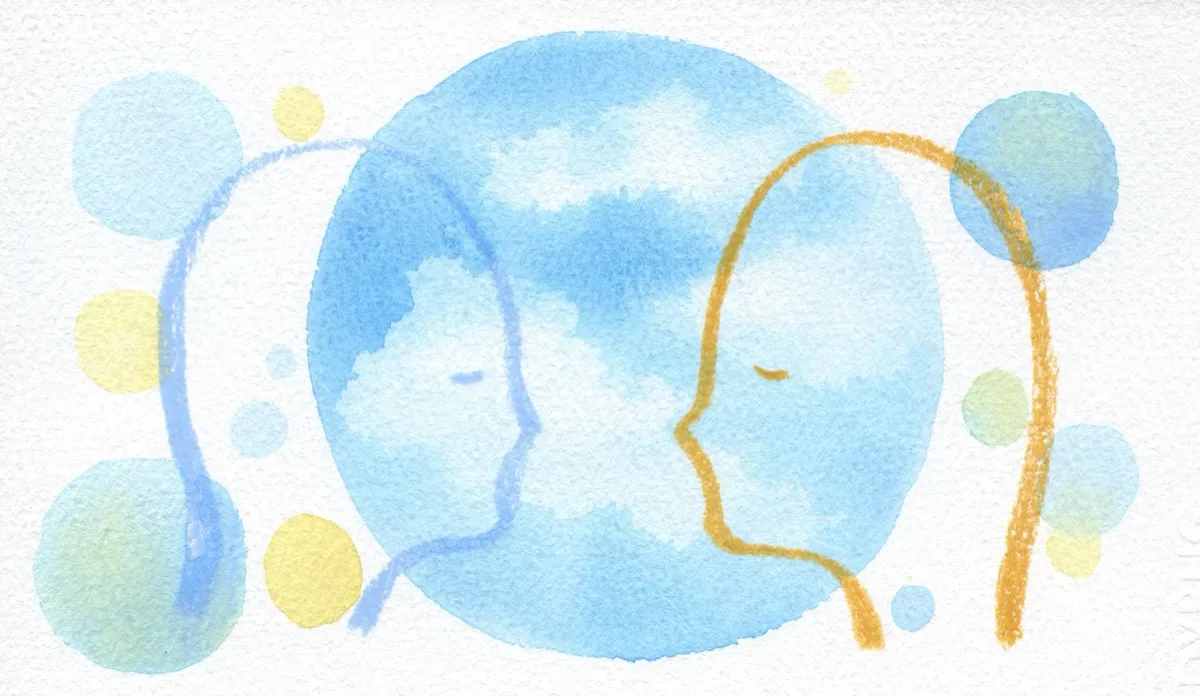
We admire someone because we see in them qualities we long for; because they have done things we never imagined could happen in this world. We hope that even after many years of experience, we too will keep eyes bright with curiosity about people and things, and a heart that meets others sincerely. We hope there can be such a person in the world — generous towards everyone, yet neither blind nor without principles.
Relationships of admiration are rare. In a lifetime, each one leaves a mark we never forget.
More common than admiration is simple curiosity: we want to know someone better, and then, given the chance, to build a new kind of relationship with them.
You join a hobby class and meet a classmate you click with; you want to talk more, and perhaps you become friends who meet often, or even partners. You scroll past a writer online whose prose is crisp, you become curious about their work, you follow their pieces for a long stretch and become a fan for a while. A friend of many years shares your taste, so when you start a business you consider working together — and you need to understand more about how they actually operate at work and as a partner.
We do not rely on our own observation alone, of course. We gather information from outside too: asking people in the surrounding network, looking up their public image online, and creating more chances to meet, observe, and interact in group settings.
Once enough of this information has piled up, we inevitably attach a whole set of interpretive labels to this person.
If the positive labels are numerous enough, and the negative ones seem negligible, we can choose to enter the relationship and begin the next mode of interaction.
Fan, friend, business partner, life partner, teacher and student…
Once the relationship is settled, we know how to interact, because society has already written the outline of the script. Broadly speaking, follow the convention and nothing much should go wrong.
That is usually how the early stage goes: there is a period, long or short, in which the other person is allowed to behave in ways beyond what we imagined — until the limit of our tolerance is finally crossed.
In a relationship of admiration, the material is more rigid. Trust in this person is far stronger, but under pressure it can also snap clean through: the admiration dissolves and you wish you had nothing more to do with them. Some people turn into what we call "anti-fans," still unable to look away from the very person they once admired, fixated on picking at every flaw out of a stubborn sense of disappointed hope.
Everyone is real; and what is real is usually complicated.
Sticking labels on someone and settling on a definition — "that's just who he is" — will never keep up with the new shapes they reveal.
They always have a little more than you thought: some particular stubbornness about a certain matter; one more piece of life history never spoken aloud, carrying a shadowed air. Or simply this — everyone's temperament shifts a little when they are worn out, usually towards irritability or gloom, and in that moment neither leaves much room for anyone else.
If your bond is the kind said to be fated from a past life, perhaps it can take that much wear. But it will still bring nights and days of turning thoughts over, needless draining friction, and over the long run it can affect body and mind.
When the other person shows a worse side than we expected, we feel disappointed in them.
Disappointment comes from expectation, from a preconceived understanding, from a definition with no give in it.
Whether it is admiration, or any other kind of relationship in this world — how do we truly see a person, rather than deciding they are the person we "imagine" them to be?
There are two roads to choose from… In truth there is no choosing: both roads must be walked all the way through. They flow into one another, and in the end they merge into one clear, open way.
First, feel this person completely.
Second, let go of the idea that you must "understand them before you can act." Let go, too, of your own fear; feel directly in this moment, and simply respond as the moment calls for.
Because what is real is, in fact, very simple.
He is just himself.
The person interacting with us right now is not an assembly of social scripts, not a construction of the labels we understand, and not someone living loftily, fed by our admiration.
He is vividly alive — exactly who he is in this moment, far more complex than any labels could assemble, and far simpler than we imagine.
The person here now also has his own feelings, as a human being, at this very moment.
When we are willing to set down our own emotions and conclusions, to release every frame and limit, and let ourselves become fully transparent, we can feel the other person clearly, with no filter.
Only then is the person you feel the real person.
What use would labels or definitions be?
And what would there be to expect, or to be disappointed by?
In this moment, you allow everything in the world to flow through you.
You are the stream murmuring down the mountain, the wide opening into the sea, the movement of all things.
You are the real, and the real is you; more than that, you become him, and he is you, and there is no separation in any of it.
A gathering of labels, or a boundless ocean?
A single turn of thought — relaxed, and at ease.
Let yourself truly be yourself, and let him be truly himself. This is the one and only relationship of its kind in all the world.
Words and images|Tsai-Jung Hsu, Chuan Tou Sketching